





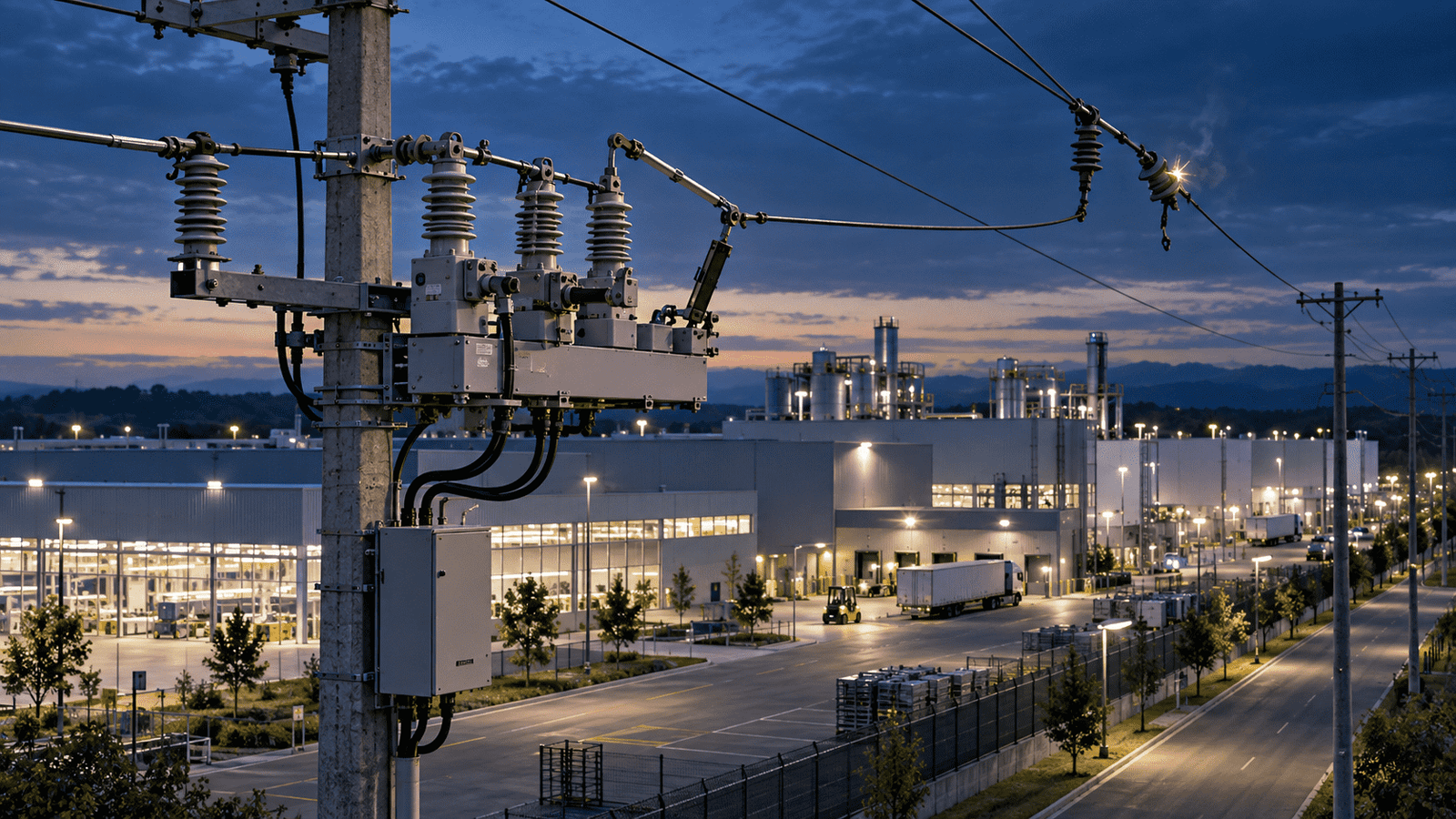
When a production line stops, the impact extends well beyond the loss of electricity. Interrupted processes, equipment restarts and revised delivery schedules all add to the cost of an outage.
One of the key objectives of electrical system design is therefore to limit a fault’s impact to the smallest practical area. Achieving this requires carefully selected protection equipment—and a clear design for how those devices work together.
A brief disturbance does not always have to become a prolonged outage
Some faults on overhead distribution lines are temporary. A momentary contact or an electrical flashover across an insulator, for example, may clear once the circuit is de-energized.
Automatic circuit reclosers help manage these events. They interrupt the fault current and then reclose according to a predefined operating sequence. If the fault has cleared, supply can resume. If it persists, the device remains open after completing its programmed sequence. The number and timing of reclosing operations are determined by the network’s requirements. Technical reference: How reclosers work.
Protection devices need to work together
A distribution network may contain multiple circuit breakers, relays and fuses. Their responses to the same fault must be coordinated.
Where network conditions allow, the aim is for the protection device closest to the fault to operate while healthy sections remain energized. This principle is known as selective protection. Poor coordination can allow a fault on a small section of line to interrupt power across a much larger area. Technical reference: Maximizing protection coordination with self-healing technology.
The role of each device also matters. Reclosers, load-break switches and sectionalizers perform different functions. Not every switching device can interrupt short-circuit current, and not every device provides automatic reclosing.
Remote monitoring supports better-informed decisions
Current and voltage measurements, device status and event records help operating teams understand what happened in the field. However, remote monitoring alone does not enable a network to isolate a fault and restore supply automatically. Those capabilities require suitable control systems, communications and protection engineering.
Before investing in new equipment, it is worth asking:
– Which section of the network will lose power if a fault occurs?
– How will critical loads be affected?
– Will existing protection devices coordinate with the new equipment?
– Can the operating team identify where and how the event developed?
The quality of an electrical infrastructure becomes particularly clear when something goes wrong. Its response to a fault matters just as much as its performance during normal operation.
Explore PowerArion’s Pole-Mounted Switchgear and Medium-Voltage Switchgear Solutions and discuss the protection and operating requirements of your network with us.